
Budget 2026 makes the case for Better Taxes

Budget 2026 makes the case for Better Taxes
To us at Tax Justice Aotearoa (TJA), Budget 2026 overwhelmingly demonstrated the need for more revenue through its continued underfunding of essential services, while on tax it was a list of small half measures, rather than meaningful reform. There was a lot of talk about the Budget being responsible because it put dealing with government debt as its main goal, but it also demonstrated a failure to invest - in our people and our infrastructure. This is a failure that has dogged New Zealand governments for decades, leading to cumulative underfunding in critical areas such as health, climate and addressing child poverty, but which seems particularly sharp at the moment.
On 2 June we held our regular post Budget Briefing session of our ongoing Tax on Tuesdays events. A panel of Bill Rosenberg (TJA Policy Advisory Committee Chair), Andrea Black (ASMS economist) and Max Rashbrooke (researcher and IDEA founder) reviewed the Budget and each reflected their own disappointments with what they had seen. This blog reflects TJA’s thinking about the Budget, informed by what our panelists told us.
Watch the TJA Budget Briefing here.
The need for more revenue
In social support, housing, health and education, the Budget had little to offer, demonstrating the need to grow Government revenue in order to maintain and build the services we all rely on, particularly the most vulnerable in society.
Bill Rosenberg pointed out that the difficulty the Government was having in reducing its spending was further evidence of the need for more revenue. The demands are real and you can’t just wish them away. Even through the lens of the Government’s own priorities, (e.g. doubling the defence budget will cost $7b by 2033) it looks like the bulk of any future expenditure will have to come out of existing programmes.
Social programmes
Pre-budget the Government announced that it was increasing the rents of state housing tenants by 20% in order to fund an increase in the accommodation supplement - a measure which seemed designed to funnel desperately needed money from some of the poorest in the community, into the pockets of private landlords. The Budget also reduced the maximum rate for Temporary Additional Support and Special Benefit that can be paid recipients (not including New Zealand Superannuation or Veteran’s Pension recipients) from 30 percent to 25 percent of the relevant main benefit rate, saving the Government just under $200m over four years.
There is no action on child poverty. Max Rashbrooke in his presentation at our Post Budget briefing showed a couple of tables demonstrating that the Government is making no serious attempt to meet the targets in the Child Poverty Reduction Act. As the table below demonstrates, the percentage of children in poverty, after housing costs are taken into account, will remain at roughly the same level until 2030 - missing the 2027 and 2028 targets by a significant margin.
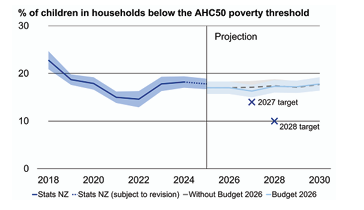
Max suggests that $3b a year is required to get back on track and enable us to meet our Child Poverty Reduction Act targets, and points out that failing to do so is a false economy, given that the cost to the NZ economy has been estimated at $14b annually.
Health
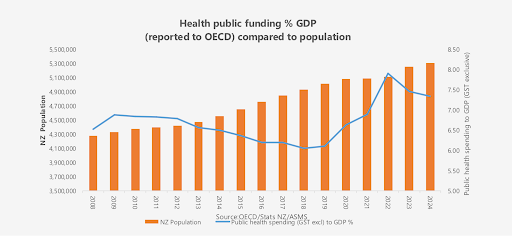
Health received $1.37b in funding, which was just about the $1.4b that Bill Rosenberg and Jackie Cummings estimated in their report for Kaitaki Hauora was necessary to maintain services at their current level. The Government made much of this investment, which hid the real funding challenge that the health system faces.
Our panelist Andrea Black shared the following table comparing public funding of the health system as a percentage of GDP, against population growth since 2008. This shows the extent of underfunding in the face of growing demand - since 2012 funding has only matched population growth once, in 2022. The effect of this underfunding, over more than a decade, is cumulative and much more is required to get funding back to the levels required.
Other deficits
Education saw a 2.5% cut in real terms (i.e. the increases they received did not match increases in costs) in subsidies for early childhood education, while schools’ operating grants saw a 2% cut in real terms.
There was no funding set aside to meet our obligations under the Paris Agreement on Climate Change and nothing to help our communities adapt to climate change.
The crisis in our public services and the climate crisis are among the many major challenges we face. We cannot continue to ignore them as this Budget does, and we need more revenue, raised through a fairer tax system to fund effective responses.
Tax and the Budget
There was no attempt at meaningful tax reform in the Budget, reform that might enable the Government to deliver health and social services at the level required to meet our needs as a society. This was no surprise, but measures that had been signalled in advance and might have made some meaningful difference to revenue, were watered down into a set of half-measures.
Bank Levy
Minister Willis had been signalling for some months that a bank levy, along the lines of similar levies in the UK, Australia and parts of Europe, was under serious consideration. We ran a poll just before the Budget which found that 52% of respondents across the political spectrum either supported or strongly supported this idea, so we were hopeful that a meaningful levy would be introduced. We estimated such a levy had the potential to raise $275-300m a year.
Instead we got a much more limited “Prudential Regulation and Supervision” levy on the banks, which will only raise $68m a year starting in 2027/28 and $208.5m over three years. The Better Taxes for a Better Future campaign (including TJA) criticised this as showing that the Government “is more interested in keeping the Big 4 Australian owned banks on side than reining in the excessive profits they're taking from the NZ economy and shoring up our resilience to any future banking failures”.
There was an associated change to tax rules for foreign owned New Zealand banking groups, increasing the thin capitalisation threshold to 12% for banking groups with a domestic systemically important bank and 11% for other banking groups which is expected to raise $13.1m a year in 2027/28 and $45.2m over four years.
Charities and Not-for-profits
Contrary to worries in the NFP sector, there was nothing in the Budget about taxing membership subscriptions as income, which was a relief. The good news for smaller organisations is that the amount of net income they can earn tax free each year is increased from $1,000 to $10,000.
The biggest measure for the sector is the capping of eligible donations for tax rebates at $100,000 a year, which looks to be aimed at putting some limits on donor-controlled charities. This falls a long way short of the ideas that IRD was consulting on to curb the misuse of donor-controlled charities. However, with this measure the Department announced that they would not be doing any more work on this issue. These measures are estimated to raise a net $15.0m in 2027/28 and $45.2m over 4 years.
Shareholder loans
Last December Inland Revenue floated some proposed changes to the taxation of company loans to shareholders. The issue was that many of these loans were either never repaid or ended up taking an unreasonable time to be repaid. In effect they became income for shareholders, but as loans they were not subject to tax. Up to $29b in shareholder loans was at stake.
TJA recommended that the legislation which has been in place in the UK for many years would provide the best solution, because the tax charge is linked to the loan and is repayable if the loan is repaid, providing an incentive to do so. However, the Government beat a retreat in the face of opposition from business, ACT and NZ First to treating such loans as dividends. Instead we have a much more limited measure on the treatment of outstanding shareholder loans when a company goes into liquidation owing tax. The amount of any outstanding loans will be taxed as income and is expected to raise $152 million over four years.
Other tax measures
There are several other tax measures in the Budget, mostly tweaks and tidy ups, but most do add to government revenue. Some of the main ones are:
- Changes to the Research and Development Tax Incentive to enable in-year payments and to expand the range of R&D expenditure mining businesses can claim. But a reduction in the cap on non-internal software for R&D from $25 million to $3 million means overall the Government will gain $87.3 million over the forecast period.
- The Foreign Investment Fund (FIF) revenue account method introduced in last year’s Budget, and targeted at migrants, has now been extended to include New Zealand residents who are invested in unlisted overseas shares. Such investors will now have the option to be taxed on realised gains instead. Furthermore, the FIF de-minimis threshold will double to $100,000. This is estimated to cost $72.5 million over five years (starting this financial year). It opens up new possibilities for tax avoidance for companies investing in “infrastructure,” as they can load themselves with debt. TJA opposed this because it weakens protections to our tax system that have taken years to build up
- The rate of duty on offshore gambling will increase from 12% to 16% on 1 January 2027, raising an estimated $56.0m over four years
Gains in revenue
Although these half measures fall a long way short of what is required, in total the tax changes will raise revenue of $397.9m net over the five years to June 2030, averaging around $140m per year in the longer run. At our Tax on Tuesdays session, Andrea described this as a return to the ‘rats and mice’ approach of the Key/English years, where small changes, together with ‘bracket creep’, provide the main increases in government revenue.
Featured News
See all news >
New Zealand Must Take A Strong Stand in International Tax Negotiations
08 October 2021
TJA is concerned about international tax rules as 140 countries, led by the OECD and G20, ed...
Read more >

Time to Tax Wealth as Well as Work
26 June 2020
TJA welcomes the forward-thinking in the Green Party’s Poverty Action Plan released today.
Read more >

New Zealand needs to stop multinational tax avoidance
24 July 2019
New research shows that multinational corporations continue to avoid paying millions in tax.
Read more >